When I qualified in medicine we knew about chromosomes; curving long threads of DNA that carry our hereditary information, about germ cells, about mitosis when chromosomes duplicate to create daughter calls.
We did not know about forensic DNA profiling, also commonly referred to as DNA fingerprinting. This should not be confused with the fingerprinting techniques carried out at countries’ borders. DNA profiling came into general use in the 1980s, developed by Sir Alec Jeffreys. It is a process whereby DNA samples are matched. Each sample shows everyone’s unique properties but also shows characteristics that are similar to their relatives. Comparison of the DNA of bones from archeological specimens with samples of the DNA of known relatives, may allow for identification of the deceased.
This process is now to be used to gain further information about the causes of the deaths of the crews of HMS Erebus and Terror. This famous expedition, led by Sir John Franklin, set out from Britain in 1845. Its aim was to find a way through the North West Passage, a route that many believed would dramatically reduce the transit time between the Atlantic to the Pacific Oceans and open up a new trade route.
None of the 129 crew members were to survive. The ships became trapped in heavy ice. Sir John and twenty-five of the crew died in 1847. The ships were abandoned in April 1848 and the remaining crew (104 men) began their desperate trek from the northwest coast of King William Land towards the mainland.
Precise details of their fate remained a mystery despite numerous expeditions to ascertain their fate, although for years fragments relating to the expedition were found frozen in ice. Erebus herself was finally located in 2014 in the Queen Maud Gulf, below King William Island, her ship’s bell was recovered in November. In September 2016, the wreck of HMS Terror was found submerged in Terror Bay, which is off the southwest coast of King William Island. Both ships were in remarkably good condition despite being lost in the icy wastes for nearly 170 years.
There is a poignant memorial to the disaster in Waterloo Place in London, which I have often studied. On the memorial are the names of all the crew members. Many theories have been advanced to explain the catastrophe: lead poisoning, scurvy, infection, notably tuberculosis. The ships were well stocked with provisions but clearly food ran out for some of the parties; Dr. John Ray who investigated the fate of the Franklin expedition in 1854, reported stories of cannibalism.
Now, researchers have extracted and sequenced DNA from the skeletal remains of 24 crew members from the expedition. The samples were from numerous different sites including King William Island. Thirty-seven tooth and bone samples were tested and DNA extracted from thirty-two and it is hoped that the work may help actually identify the crew by comparative DNA (if living descendants can be found), also that information about the cause of death will be obtained. The study was recently published in the Journal of Archaeological Science: Reports. Four of the samples were identified as females; unexpected, as the ship’s documentation did not record women on board. Two possibilities relating to this finding are a) the DNA has degraded over the 160 years since the crew were lost or b) that there were women actually serving in the ship dressed as men – this is thought unlikely, it would have been difficult for four women to successfully concealed their identity. Another study found zinc deficiency in toenails of one of the mummies.
The expedition remained in the public conscience for years. The suggestion of cannibalism apparently infuriated Charles Dickens who collaborated with his friend Wilkie Collins on a Franklin based play The Frozen Deep. Landseer’s painting Man Proposes, God Disposes, shows man ‘proposing’ in the form of a shipwreck and God ‘disposing’ in the form of two bears. But the discovery of Franklin’s ships is one of the most important archeological finds in exploration history. Finding the ships has been likened to the opening of Tutankhamun’s tomb. Stephen Harper, Canada’s Prime Minister in 2014, emphasized the importance of Franklin’s ships in Canadian history – the expedition laid the foundation for Canada’s Arctic control- all the waterways in the North –West Passage are claimed as Canadian.
.
Sir John Franklin’s Erebus and Terror
19 MayFRANZ – JOSEPH LAND
29 AprWilliam Speirs Bruce visited Franz-Joseph Land in 1896 as a member of the Jackson–Harmsworth Expedition (1894-97), eager to further his apprenticeship in the natural sciences within the icy environment of the Arctic.
Franz-Joseph Land is an archipelago of nearly 200 islands. At 80 -82 °N, it was and remains, ice bound for much of the year. The Franz-Joseph Expedition, which he joined, aimed to survey the Land and, if possible,find a way to the North Pole. This expedition became newsworthy, when Fridtjof Nansen and Hjalmar Johansen (who had not been heard of for three years and were assumed to have perished on their attempt to reach the North Pole),reached Franz -Joseph Land on their southern retreat, a month before Bruce arrived. Nansen was supportive to Bruce who always wanted to return to the icy archipelago and who was persistently concerned about ‘foreign’ interests in the Arctic Islands. He was dismayed at the Russian annexation of Franz Joseph Land in 1914. The Russian steamer ‘Gherta’ reached the archipelago on the 18th August and hoisted the Russian flag.
Bruce was prescient in sensing the huge potential of the Arctic Islands. The
Arctic is now thought to account for 13% of undiscovered oil, 30% of undiscovered natural gas and 20% of natural gas liquids – possibly one-quarter of the planet’s undiscovered oil and gas and worth in the region of $30 trillion (£21.1 trillion).
Russia has built bases on Franz Josef Land to the concern of the US and other nations.These bases can house about 150 people for up to 18 months and are equipped with every facility including, it is said, nuclear- ready warplanes. This reinforces both Russia’s defense capability, and her other interests in the region and could be considered a threat to Finland, Sweden, Norway and other countries interests in the Arctic region.
In 2015 Russia submitted a revised bid (the first turned down), to the United Nations for territories in the Arctic claiming over 463,000 square miles of Arctic sea shelf extending more than 350 nautical miles from her shore. President Putin has visited the archipelago, again emphasising the need to protect Russia’s economic and security interests in the Arctic.Russia has an active Arctic Brigade.
According to some estimates, the Arctic summer ice cap will completely vanish by the year 2050. This will improve access to the Arctic resources, hence bringing more challenges.
Clearly the region is a political hot spot, demanding international statesmanship and co-operation, hopefully without confrontation.
Fridtjof Nansen said ‘The great thing is to move forwards responsibly, steered by the best knowledge we can gather’ Lets hope this happens.
Image Fox News
ALASKA
18 AprIt is a remarkable thought, when Russian – American relations are at a low point, that Alaska was once part of the Russian Empire. Russia sold Alaska to the United States 150 years ago. If Russia were in possession of the territory today the geopolitical situation would be unrecognisably different.
The first Russian settlement in Alaska was founded in 1784. This was followed quickly by other settlements. The attraction was sea otter fur, which was greatly in demand. The otters in Alaska had thicker, glossier and blacker fur than those on the Pacific N/W coast and California i.e. more sought after. British settlements in Alaska at about this time consisted of a few scattered trading outposts though Captain James Cook had sailed and charted the west coast of North America on ‘Resolution’ in 1778. (One of his midshipmen was George Vancouver who was to return and chart the west coast, hence Vancouver and Vancouver Island).
Over the next century, Russia lost the Crimean War (1853-56), her monopoly on trade was weakened by the British Hudson’s Bay Company, which set up a post on the southern edge of Russian America in 1833, there were concerns about a potential gold rush with an attendant influx from America, finally, the supply of otters diminished drastically.
These financial difficulties and low profits, coupled with the desire to keep Alaska out of British hands contributed to Russia’s willingness to sell its possessions in North America.Czar,Nicholas II also hoped the deal would result in a closer relationship with the United Stated (and a potential union against Britain). On August 1, 1867 U.S. Secretary of State, William Seward, approved the purchase of Alaska for $7,200,000. The United States flag was raised on October 18, 1867 (now called Alaska Day); the region changed from the Julian calendar to the Gregorian calendar.
The purchase was not universally popular: ‘Seward’s Folly’ and ‘Seward’s Icebox’ were some of the comments. The foolhardiness of slavishly following popular opinion has been amply shown subsequently in relation to this purchase.
In an article in The New York Times, (31/3/2017), Evan Gershkovich, writes that ‘Russia’s sale of Alaska was a day of mourning for some hard-right Russian nationalists who see the transaction as a gigantic blunder by the ailing Czarist Empire, one that reverberates as the major powers vie for influence over the arctic and its natural riches in an age of climate change’, a comment vividly illustrated by the fact that there is oil in the bedrock below waters surrounding Spitsbergen and the Spitsbergen Treaty finishes in 2020. Mr. Putin has apparently commented that the development of a missile system in Alaska is one of the most pressing security issues.
President Dwight Eisenhower signed the Bill for Alaska to become the 49th State of the Union in 1959. Congress passed the Bill on 3 January.
This sale would never have happened after the Russian revolution. It could be said that Seward’s purchase of the territory was the best ever use of Federal Funds. Perhaps there should be a Seward Day.
Reminders of Captain James Cook
31 MarI have recently made short visits to Singapore, Melbourne, Sydney, various places in New Zealand and Vancouver
On the visits I became increasingly overawed by James Cook’s achievements of the 1770s: He has a presence in all of these venues which recognise his momentous accomplishments – he completed two round-the-world explorations: on ‘Endeavour’ 1769-1771 and on ‘Resolution’ 1772-1775. His third voyage, when he sailed on ‘Resolution’, left England in 1776. On this voyage Cook was killed on 14 February 1799, by Hawaiians on the return voyage which followed his attempt to find the North West Passage. The voyage lasted from 1776-1779. On Cook’s expeditions his crew was kept free of scurvy by eating sour kraut and a marmalade of carrots.
In relation to my peregrinations:
In Singapore there is a James Cook University, this is a branch of the James Cook University, based in Townsville, Australia.
In Australia, Cook is well remembered. His first landing was in 1770; the site was suggested as a site for a British colonial outpost. Some years later the location was found to be unsuitable for a settlement/penal colony and a community of SYDNEY was established in a harbour a few kilometres north of the original landing site. It was from here scientists started the first European scientific documentation of the Australian fauna and flora. To day there are impressive statutes of Cook in Sydney, one erected by Yorkshire men. This first voyage was made when he was still a lieutenant. In the course of this groundbreaking expedition, he charted the eastern coast of Australia and named prominent landmarks.
In Melbourne Cook is remembered particularly in Cooks’ Cottage, the oldest building in Australia. The cottage was built in 1755 in Great Ayton, North Yorkshire England by Cook’s parents and brought to Melbourne by Sir Russell Grimwade in 1934. Each brick was individually numbered, packed into barrels and then shipped to Australia. It is a big visitor attraction.
Cook had actually sighted New Zealand before Australia – on 6 October 1769. He landed at Poverty Bay and went on to organise detailed maps of the country. He observed and wrote about the Māori people. He returned to New Zealand on his second voyage and there is a lovely image, painted by William Hodges the expedition artist, of the ‘gang plank’ –a large tree trunk that was used to off load Endeavour at what was to be named Pickersgill Bay. (Pickersgill sailed as third lieutenant on Cook’s second voyage. He has several geographical features named after him in N.Z. and in Australia). From New Zealand Cook explored the Society and Friendly Islands, before crossing the Antarctic Circle and reaching as far south as 71°10’S. He never actually saw the Antarctic though was certain of its existence. He made a mistake in thinking that there was no useful future to be had in further exploration of the forbidding south. He thought it was ‘doomed by nature to everlasting frigidness’ had a ‘horrible and savage nature’ and that ‘a deeper exploration would require resolve and fortitude and would give no benefit to the World’.
The Auckland Arts Festival is going on at present. One of the artistic exhibits a ‘House of Lights’, homage to Cook. This shows a super-life -sized statute of him, in a smooth silvery finish, sitting with his elbow on his knee and looking out to sea. He is seated in a purpose built ‘house’ on the end of a pier, which has brightly coloured representations of the stars that Cook charted his course by. The lights come on in sequence and shine brightly at night.
Vancouver has a big interest in Cook who was the first Englishman after Francis Drake to see both coasts of North America. Cook came to the west coast coast on his third voyage, on his way to find (or disprove the existence of) a western route to the Northwest Passage. In late March 1778, the ships anchored in a small, sheltered bay in the middle of a sound, and parties went ashore. They were the first Europeans on record to set foot upon what became known as Vancouver Island. A midshipman George Vancouver was on this voyage and he wrote that it was ‘the most lovely country that can be imagined’. Captain Vancouver returned in 1791 on an expedition that explored and charted the North West Pacific coast of America. Vancouver Island and the city of Vancouver are named for him, as are Vancouver Washington and Mount Vancouver.
The Royal British Columbia Museum BC in Victoria BC has a real sized section of Cooks second ship on his 1776 expedition, Discovery. It is an excellent montage.
What achievements! The first command was occasioned by him being appointed by the Royal Society as its chief observer of the transit of Venus and to find information about the southern continent. The second expedition also had the continent as its main objective. The third was concerned with the North-West Passage. Amazingly, France, the United States, Spain and Russia extended a safe conduct in the war period (The American War of Independence). He is regarded as the greatest of navigators and cartographers.
CANTERBURY UNIVERSITY, CHRISTCHURCH, LYTTELTON, EDWARD AND ORIANA WILSON
16 MarI have just given a talk on Edward Adrian Wilson at the University of Canterbury, I spoke to the Antarctic Society (Canterbury branch) and the Canterbury Historical Association,– a really pleasurable occasion.
There is much interest here in the early 1900 expeditions, which came to Christchurch and sailed to the Antarctic from the port at Lyttelton. There is also a very particular connection between Edward and Oriana and New Zealand -the couple had married in 1901, only three weeks before ‘Discovery’ sailed off into the unknown and their delayed honeymoon took place in New Zealand after ‘Discovery’ returned to Lyttelton in 1904. They loved the country and wanted to make their home here. Wilson’s ambition was to record of the local flora and fauna for posterity.
In 1912 Oriana lived for a year in Sumner, Christchurch, staying in ‘Terra Nova’s reassembled old meteorological hut. She was eagerly awaiting her husband’s return. She was to read the devastating news of his death on a billboard –he had been dead for nearly a year and she never really recovered from the blow, though always continued faithful to her husband’s legacy and interests. She made many friends in New Zealand and returned regularly, she made careful recordings of the bird life. Her lifelong connection with the country was rewarded with the CBE, awarded for her war work for the New Zealand government.
But following the two devastating earthquakes of 2011and 2012, the Christchurch that Oriana would have known, the elegant Anglo/Scottish city on the Canterbury plane is no more. Ninety percent of the historic buildings have been demolished. There have been painful years of deconstruction and large areas of flattened buildings remain. On a positive note the city is now reconstructing and rebuilding apace. A modern city center, in an earthquake proof style, is emerging.
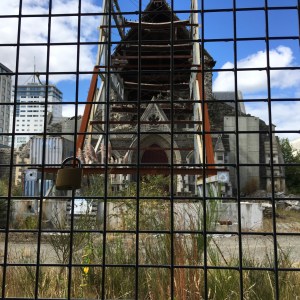
The cathedral remains an area of contention. Some want restoration of this iconic symbol of the city forefathers- a little piece of the old country – whilst others favour a modern replacement, I imagine, similar to Coventry. The decision is still to be reached.
Lyttelton can now only be reached from Christchurch by road and train tunnels. Its old stone buildings and warehouses were destroyed, though amazingly, the wooden houses in the amphitheater of hills around the port have survived. The port is active, but passenger ships are currently diverted to Akaroa along the coast.
We have driven over 2.000 km in the N. and S. Island, New Zealand is a beautiful country: beaches, rollers, majestic mountains, farms, vineyards, museums (I was particularly impressed by Wellington and Napier) and the oceans. I can completely understand Edward Wilson’s wish to return and I want to return again. I hope reconstruction will proceed apace.
EDGAR EVANS and TYLOR FORD
10 FebWhen I wrote ‘Captain Scott’s Invaluable Assistant, Edgar Evans’, I was very aware of the posthumous blame attributed to him in some quarters, for causing the deaths of the rest of the Polar party.
On the return from the Pole all the British party suffered from malnutrition with associated muscle and fat wasting. Edgar was affected the most. The men had equal shares of the rations. Edgar, the biggest man in the group, needed the most calories. In addition I think he had a bacteraemia (infection with bacteria in the blood stream), following a cut to his hand.
Reports at the time made no suggestion of a physical illness but rather, focused on psychological causes:
a) He was the only Rating and therefore isolated.
b) He was depressed that he would not be able to open his pub on The Gower.
c) Most upsettingly, it was suggested that because he left full-time schooling aged 10, he did not have the education to withstand the monotony of the long trek to Base after the British reached the Pole behind the Norwegians. (The thought that Oates consoled himself in his agony, by reciting Virgil, as he trudged across the ice, is ludicrous).
When the news reached England, Edgar was not included in the cigarette card illustrations that were avidly collected and seem to have included pictures of every other explorer, including Amundsen’s team; a book for children indicated that he had failed; illustrated publications missed him out completely. A sonnet included the words that it was as well that he did not know that his deterioration had caught his companions in ‘death’s snare to hold them fast’. The distress and humiliation suffered by his mother, wife and children must have been great.
I am so pleased that Edgar is having a renaissance. The Edgar Evans Club in Portsmouth, run by Rob de Silva and Ginge Fullen is exactly the project that he would have supported; also the fact that his great- great grandson, aged nine, has clearly inherited his strong, burly physique is fascinating. Tyler Ford is the Welsh, British, European and World Kick Boxing and Tae Kwon-do Champion. Tyler’s father writes that Tyler is climbing Snowdon this month in memory of his great granddad, he is also going to Dublin to fight in the world fight series.
Life in Antarctica
29 JanI have been writing my book on William Speirs Bruce for years (and years).For the past nine months I have been joined by a co=author John Dudeney.
John is in the Antarctic at present and I asked him to send me a short piece about his life there.
This is it:
I am sitting in my cabin on the Akademik Vavilov and outside my porthole is the Gerlache Strait, with the snow covered mountains and glaciers of the Northern Antarctic Peninsula towering over the ship. I have been fortunate enough to have had a career spanning 40 years living and working in and about the Antarctic, followed by a further ten years visiting every year as a guide/lecturer. So this trip is rather special to me, being 50 years since I first encountered, fell in love with Antarctica, and spent two years living here as a scientist and a Base Commander.
Today the sea is calm and the wind light. Flocks of Cape Petrels with their characteristic black and white wing markings are swooping over the sea alongside the ship. The sea is continually being marked by the blows of humpback whales Port and Starboard of the ship, often “fluking” (diving and showing their tails as they do so) to feed on the rich harvest of krill. Sometimes we are thrilled by the sight on one of them “breaching” – leaping right out of the water – a fantastic sight with the majestic mountain landscape as a backdrop. Giant Petrels soar imperiously in the breeze alongside the ship, while their diminutive cousins –the Wilson Storm Petrels – dance over the sea surface, flitting to and fro as they feed on Krill. Occasionally groups of penguins will come porpoising by, busily going about their duties of collecting food for their chicks. And icefloes will have small groups of Crabeater seals lazing away in the sunshine.
Icebergs surround the ship in all sorts of shapes and sizes. Everyone is unique and their shapes make the imagination run wild. Their colours range from sparkling white to deem iridescent blue and green, and occasionally they are marked with lines of soil and ru bble which has come from the grinding of the glaciers as they slowly, so slowly, push their way to the sea.
Over the next few days, as the ship steams south we will have opportunities to land on the continent to hike and to just sit and contemplate penguins in their thousands in their colonies as they go about their business of rearing their young – defending them (mostly successfully) from the prowling predators – Skuas, Giant Petrels and Sheathbills.
What could be better? It certainly beats sitting at home with the barrage of Brexit and Trump news, non-news and speculation!
Edgar Evans great-great grandson, Tyler Ford
15 JanIn 1907 a centrepiece of the Royal Naval and Military Tournament was the Field Gun Run, a competition that had evolved after Royal Naval involvement in the relief of Ladysmith during the Boer War. At this time Edgar Evans was the Gunnery Trainer at HMS Excellent and he led the Portsmouth team in the competition. This tremendous feat involved two competing teams hauling a ton of gun and carriage towards a wall (a steep incline), dismantling the gun and its wheels to get it over the wall, reassembling it then dismantling it again to swing it it over a twenty-eight foot ‘chasm’, putting it all together finally for the race for the ‘enemy’ line. Edgar’s team won the competition. He was a good organizer and very strong. His strength and bulk were often commented on before the ‘Terra Nova’ expedition.
The genes will out! Now Edgar’s great-great grandson, Tyler Ford, aged nine, is the British, European, and World Kickboxing Champion and the Number 1 Junior in the world. He is the youngest ever to be included in the Martial Arts Hall of Fame. He lives in Swansea, is regularly interviewed and photographed. Teresa May has sent a letter of congratulation over his achievements.
This is a remarkable achievement. Edgar would have been proud.
Antarctic Ice
1 JanIt’s remarkable that winter sea ice surrounding the Antarctic continent has increased
significantly in recent decades; a record level at 20.000.000 square km has been recorded.
This goes against the trend of overall ice loss and is in contrast to Arctic ice that has
decreased to a much greater extent (two thirds more,) than the increase in the South.
Sea ice in the Antarctic winter reached record highs between 2012 to 2014, though returned
to average levels in 2015. By contrast In the Arctic, both winter maximum and summer
minimum sea ice extent have declined sharply. Since the late 1970s the Arctic is said to have
lost an average of 20,800 square miles (53,900 km), of ice per year while the Antarctic gained
an average of 7,300 square miles (18,900 square km). The cause for this is, I understand,
uncertain. A possible explanation is that there is a low-pressure system over
the Amundsen Sea (on the west coast of Antarctica). This changes wind patterns,
circulating warm air over the peninsula (with consequent loss in sea ice) and sweeping cold air
over the Antarctic continent towards the Ross Sea. Other suggestions include melting ice
on the edges of the continent. This is at just above freezing, and can easily refreeze into sea ice
I understand. Changes in water circulation bringing colder waters to the surface has also been
suggested, also snow which pushes thin ice below the water surface and allows seepage of sea water
into the surface snow with subsequent freezing.
Victor Hayward
10 Dec
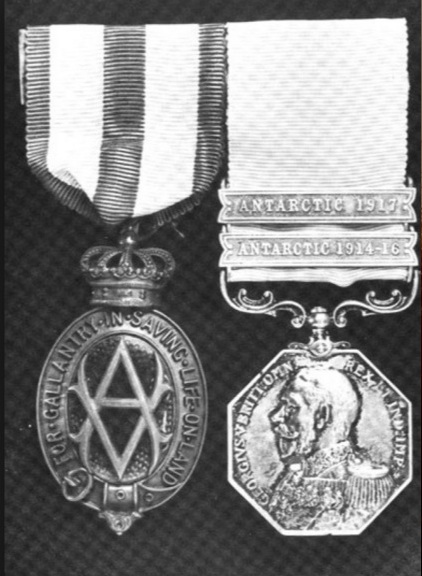
I was interested to see that the Albert Medal and the Polar Medal, awarded to Victor Hayward, are to be auctioned. It is anticipated that thousands of pounds will be realized. I am delighted that there is still such interest in the expeditions of the Heroic Age.
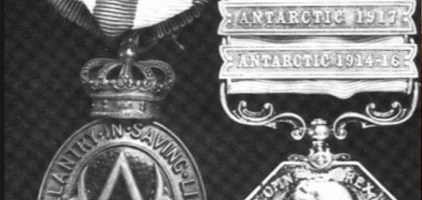
The Albert Medal was awarded for the saving of life on land or sea (two medals with different inscriptions depicting the two groups). The medal was discontinued in 1971 and replaced by The George Medal. The land version, which was awarded posthumously to Victor, was in red with a red and white ribbon.
The Polar Medal is awarded to citizens of the UK and Northern Ireland who have made conspicuous contributions to knowledge of the Polar Regions, or who have
given service of outstanding quality in support of acquisition of this knowledge and who, in either case, have undergone the hazards and rigours imposed by the Polar environment.
It is greatly valued. William Speirs Bruce, whose biography I have just completed, battled unsuccessfully for years to get the medal awarded to members of his Scotia Expedition The medal is octagonal, with a white ribbon. It depicts a ship surrounded by ice floes. The obverse has a portrait of the reigning monarch, in Victor’s case George V.
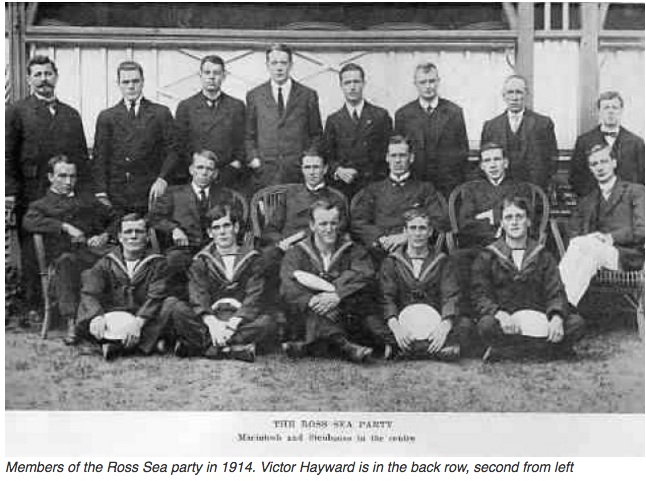
Shackleton’s support team went to McMurdo Sound. Their story has been overshadowed by the Endurance saga. The Captain of the Aurora was Aeneas Mackintosh. Victor Haywood was a member of the Ross Sea party, which included the Reverend Arnold Patrick Spencer Smith and seven other members. Mackintosh was in charge of laying a series of depots across the Great Ice Barrier from the Ross Sea to the Beardmore Glacier for Shackleton to pick up when he had crossed the Antarctic from the Weddell Sea. Shackleton’s party could not carry sufficient food and fluid for the entire journey and depended on these depots for the final quarter of their journey (as is well known, in the event, Shackleton did not actually make landfall on the Antarctic as ‘The Endurance ‘became icebound, and drifted around the Weddell Sea from February 1915 to November 1915, when she sank.
Mackintosh sailed to Antarctica from Tasmania. On arrival in Antarctica three camps were prepared, the largest in Cape Evans, Scott’s hut of 1910, the second in Hut Point Scott’s original camp of 1902 (relatively poorly equipped and separated by sea/ice from Cape Evans by thirteen miles), and thirdly at Safety Camp, a staging area from which the parties would set out for the south. Mackintosh followed instructions with enormous difficulty. The first party, January to March 1915, reached 80 degrees S. At each parallel they left depots, made out of ice blocks to about 12 feet and topped by a high black flag. By the time they returned to Hut Point they had lost all of the ten dogs they had taken.
In May 1915 the Aurora was torn from her moorings in a gale and carried out to sea. The men at the base were marooned.
Mackintosh and his party spent the winter preparing to set up more depots in the south. The second depot laying party worked from September 1915 in three teams of three. A failure of a primus stove meant that three of the party returned to Cape Evans leaving six to sledge south. During the journey the Reverend Spencer-Smith failed rapidly and became so debilitated with scurvy that he had to be left behind in a tent whilst the others progressed south, passing the 83 parallel (where Shackleton had turned back from his ‘Furthest South’ in 1909). They finally got to the base of the Beardmore Glacier leaving a depot with two weeks supply of food and fuel.
On their return the party picked up Spencer Smith. When Spencer-Smith was alone and dying slowly in his tent, he hallucinated and wrote notes that are touching to read – he thought that the war was over, that Sir Ernest and Frank Wild had appeared, both clean and neat, and that he had spent the day delivering a sermon in execrable French. He was conscious enough to write ‘Laus Deo’, as the team approached his tent. The return journey was terrible. Both Mackintosh and Spencer-Smith had to be pulled on a sledge and Victor Hayward was also very weak, but he looked after his two ill companions putting their wellbeing above his own and it was for this service that he was to be awarded the Albert Medal. As the awful return continued, Mackintosh was left behind behind as Victor and Spencer-Smith were taken north by sledge. Spencer-Smith died, worn out by exhaustion and scurvy. On the return there was no conversation ‘all our energies are needed for the job in hand’ -to bring the party to the relative safety of the Hut Point shelter where Victor recovered slowly. Mackintosh was able to follow later.
The party reached the Hut Point camp in mid March. Here they were marooned waiting for the ice between Hut Point and Cape Evans to be strong enough to stand their weight. They ate seal meat morning, noon, night. They lived ‘like troglodytes’.
On May 8th Mackintosh and Victor Hayward decided they had had enough of the conditions and the unending seal meat. They decided to cross the thirteen miles of ice to Camp Evans (warm and well supplied with food in comparison to Hut Point). They left against the advice of their companions, who watched their figures slowly becoming fainter and fainter in the dim light. Two hours later a blizzard swept over the Sound Mackintosh and Hayward were never seen again. They could have fallen through the ice, or been carried out to sea when the ice broke up. If, by any chance they had managed to reach land, they would have succumbed to hypothermia.
Seven years later, in 1923, Hayward was posthumously awarded the Albert Medal for gallantry, in recognition of his efforts to save the lives of Mackintosh and Spencer-Smith on the Barrier. The award of the Polar Medal recognized his prolonged support, service and contribution to advances of knowledge in the Antarctic. He was a man who had suffered and endured the hazards and rigours of the continent with courage.
.
.