Archive | Uncategorized RSS feed for this section

GEOGRAPHICAL: August 2012, Worldwatch, Scott and his men starved to death

3 Aug


Mike Stroud and Lewis Halsey, (reported in the ‘Geographical’ in Worldwatch P.12), conclude that  Scott’s party starved to death. This is undoubtedly true. By the time Edgar Evans died on 17/02/1912 the party has been on the summit rations of 4,400 kilocalories since early December 2011.They thought they had adequate rations but current nutritional information shows that each man probably burnt 7,000 kcal per day whilst manhauling. This means that by the time Evans died, each man would have had an astounding calorie deficit of at least 170, 000 kcal and lost over 35% of his body weight. The rations simply did not supply enough calories for their needs and they lost a huge amount of their insulating body fat. All the men suffered in addition from a lack of fluid, dangerously low body temperatures and vitamin deficiency. But in spite of this the men might have got through if it were not for medical factors.


Edgar Evans had problems before the party got to the Pole and there are frequent referenced to his enfeebled condition as the party battled across the featureless landscape. When the party descended the Beardmore Glacier he deteriorated dramatically.  He had cut his hand whilst shortening a sledge on December 31, 1911, the cut festered and needed daily attention from Dr. Wilson.  His fingernails fell off; his fingers were raw, swollen stumps.


Staphylococcus aureus is a bacterium commonly carried in the nose and on the skin. I think it is very probable that this bacterium infected Edgar’s hand and got into the bloodstream causing repeated infections. This medical complication would have been more than enough to exacerbate Edgar’s deterioration and contribute to his weakened condition, which so slowed the party’s return.


As is well known, Captain Oates, stoical and courageous suffered with an appalling gangrenous foot. It took him nearly an hour to get into his boots. He could not pull the sledge. As is well known he eventually crawled out of the tent so as not to further prejudice his companion’s chances of getting to their base.


Without the slow progress imposed by the medical conditions of these two heroes the British Party might have succeeded in reaching One Ton safely.

 

HAD WE LIVED: AFTER CAPTAIN SCOTT by RICHARD JOPLING

26 Jul

‘Had We Lived’ has at its centre, Apsley Cherry-Garrard, the leader of the dog team that took supplies for the returning Polar party. The blurb about this book on Amazon has some sentences that merit comment.

Three quotes are given in order of appearance!!

1) He died in 1959, still regretting having abandoned the men he admired and loved most in the world.

‘Abandon’ implies that Cherry-Garrard knew the returning party was alive, a fact that, however much he might have wished it, he could not have known. Cherry-Garrard, inexperienced in both navigation and dog driving, was sent to One Ton with Dimitri Gerof because the only other man who could have gone, Silas Wright, was needed for scientific work. Cherry’s orders from Dr Atkinson were to take dog food and food for the men to One Ton Camp. He was informed that Scott was not dependent on the dogs for his return. Also, that the dogs were not to be risked but saved for the following year. At One Ton the dog food was low, the weather was bad, to push further South over the featureless plain would have been pointless and Cherry would have felt this, but, devoted as he was to the Polar Party, particularly to Wilson and Bowers, he might have done so if it were not for his orders. He obeyed these.

2) Cherry’s childhood and young manhood in Lamer, their stately home in Surrey.

Lamer is in Hertfordshire. Part of it still remains. Cherry inherited from his father, General Cherry who had inherited the estate from his father-in-law on condition the family assumed the name of Garrard. So they became Cherry-Garrard in 1892. When Cherry wrote the ‘Worst Journey’, he consulted with his friend George Bernard Shaw, a well-km=known Hertfordshire resident, who lived near by.

3) The second part of the novel leaps forward to 1958. Cherry is now old and suffering from physical and psychological damage caused by guilt and regret, feelings which have haunted him since the failure of Scott’s expedition. 

This may well be true but there may be genetic factors that caused depression also. Cherry’s cousin Reginald Smith 1857 -1916 (of the publishing company Smith Elder) committed suicide in 1916 having suffered from depression for years. He was known to have suicidal tendencies. Thus, there may have been a familial tendency to depression in the family.


David’s Bookshop. Letchworth Garden City

19 Jul

One of the pleasures of giving talks is the places that I visit. This week was David’s Bookshop and Music shop in Letchworth, a lovely, independent bookshop that arranges presentations monthly and has some interesting people booked to present. I took two granddaughters with me, a small challenge! but the audience was involved and informed, as judged by the questions.

Letchworth Garden City was the first Garden City. It was designed by Ebenezer Howard. He had lived in Chicago after the great fire of 1871 and watched the regeneration of the business district. He was also influenced by Lever and Cadbury to design a city that mixed urban and rural sections. Welwyn Garden City was built on the same lines — factories, houses, shops, businesses combine with a rural influx  of trees and water. It is remarkably successful

Hektoen International Journal of the Medical Humanities

19 Jul

Hekoten International Journal.

I have a piece on Edgar Evans in this month’s excellent on-line publication (Vol. 4 Issue 2). The journal covers an interesting variety of topics each month, this month, for example, the Death of Charles II and an article about Emily Dickinson are covered, amongst other topics.

I am fascinated by little gems of historical interest and will follow it from now on.

Edward Wilson and Glorious Gloucester Cathedral

11 Jul

Gloucester Cathedral IS glorious. Originally St Peter’s Abbey, founded in the 11th century, it was one of the great Benedictine monasteries for 500 years until it was dissolved by Henry VIII in 1540, when he broke his allegiance to the Pope and Catholicism. This was ‘a moment of shattering change’ with the loss of the monks, pilgrims and many of the monastery’s wonderful treasures, which disappeared into eager secular hands.

A Bishop of Gloucester was appointed with duties in the parishes and diocese and where St Peter’s had been an Abbey, there was now a cathedral.

It is difficult to know what to be more impressed with; the building itself is magnificent and in it there is exquisite fan vaulting, wonderful stained glass, including three vivid blue windows created by Tom Denny in 1993, tombs (Edward II amongst them, also Robert Curthose, in vivid red, lying relaxed, one spurred foot across the other), the silver, the books, the masonry.

Edward Wilson loved Gloucester Cathedral. He was confirmed by the Bishop of Gloucester, Dr Ellicott, ‘the good Bishop laid his hands on me’. A compulsive artist, he drew the interior of the building.

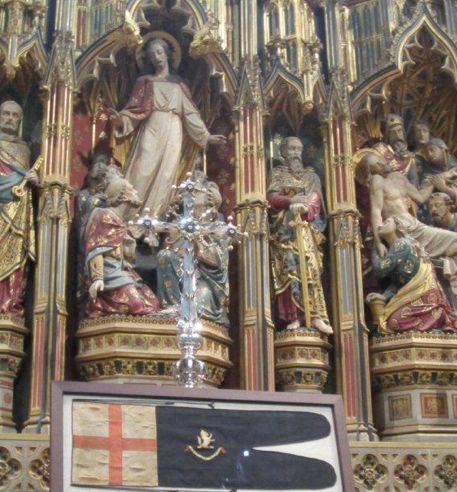
On July 5th the cathedral dedicated an afternoon and evening to Wilson’s memory. I gave a talk about his life in the Chapter House. His sledging flag, which was sewn by his wife Oriana, was brought from The Scott Polar Institute for the occasion. A service gave thanks for his life. His poem ‘The Barrier Silence’ was read.

The service ended with Scott’s letter to Oriana Wilson: ‘If this letter reaches you Bill and I will have gone out together……. his eyes have a comfortable blue look of hope and his mind is peaceful with the satisfaction of his faith in regarding himself as part of the great scheme of the Almighty……. he died as he lived, a brave, true man – the best of comrades and the staunchest of friends’.

Sledge flag


Gloucester Cathedral and sledge flag

Meeting at Jaffrey 15-17 June The SouthPole-sium

26 Jun

This was fantastic! About 60 delegates: authors, artists, mountaineers, collectors, dealers. A real meeting of minds and the hospitality and entertainment provided was fantastic too. All organized by Rob Stephenson of the Antarctic Circle. Jaffrey is a very attractive town and of course, New Hampshire is well known for its beauty.

Richard Pierce had a book launch for his new book ‘Dead Men’ which went well and many delegates contributed. To mention a few presentations, there were talks on the Japanese expedition to Antarctica of 1910, Tom Crean, The Falkland Islands, Antiquarian Collectors, Tristan da Cunha, The Scott Polar Research Institute, also beautiful Arctic images. It was a real meeting of minds. The emphasis was on short presentations and much discussion.

I spoke on Edgar Evans and also made a presentation in the ‘Toadstool Bookshop’ in nearby Peterborough.

It was a great occasion!


EDWARD WILSON’S PAINTINGS AND DRAWINGS

8 Jun

When he was a young man Wilson was an admirer of Ruskin. This meant that anything he drew of painted had to be absolutely accurate – nothing added, nothing taken away. His (often beautiful), drawings were absolutely precise. As he became older he started to follow Turner. This is not so odd as it appears; Ruskin wrote a defence of Turner in ‘Modern Painters’. Ruskin seems to have loved Turner because of what he (Ruskin) saw as Turner’s truthfulness to nature and Turner’s revolutionary distain for the conventional way in which most of Turner’s (and Ruskin’s) contemporaries painted landscapes. Turner combined imagination with his observations. He was innovative and came closer to nature than any other artist had done since Claude (who Turner greatly admired). Turner showed a new understanding and knowledge of nature and of her structure, but he also depicted her spirituality and Ruskin was the critic who understood this.

Edward Wilson chose two artistic giants to model his work on

Shackleton

9 May

Shackleton was an inspiring leader in adversity, he gave hope. In my talk on Shackleton I go over the three expeditions ‘Discovery’, ‘Nimrod’ and ‘Endurance’, each one follows inexorably after the other.

He is said to have advertised his Trans-Antarctic expedition: ‘Men wanted for hazardous journey. Small wages. Long months of complete darkness. Constant danger. Safe return doubtful. Honour and recognition in case of success’.

He had thousands of applicants including a wonderful letter from ‘three sporty girls’, who were ‘strong and healthy, gay and bright’. Then, excellently, ‘If our feminine part is inconvenient we should be happy to don male attire’. They had been reading up on the Polar Regions and couldn’t see, ‘why men should have the glory and women none’ especially as there were women who were as capable and brave as men. They were not accepted!

Interestingly, they were not the only females who were interested in Antarctic exploration. Marie Stopes, of birth control fame, was an eminent botanist and biologist. She was particularly interested in glossopteris (seed ferns), which flourish in warm climates and she wanted to investigate their presence in Antarctica, which  would prove that the Antarctic had once been a warm climate. She discussed this with Scott before his ‘Terra Nova’ venture and he promised to bring back samples. These were found in the tent with the dead bodies of Scott and his companions in 1912, and did indeed confirm the theory.

There is no suggestion that Stopes wanted to go with Shackleton. She was 44, getting divorced, and no doubt her thoughts had moved on from pure research

Memorial plea for Scott’s mate

10 Apr

There is a piece in ‘This is South Wales’ published yesterday:

http://www.thisissouthwales.co.uk/Memorial-plea-Scott-s-mate/story-15761797-detail/story.httm

It draws attention to the increasing interest in a memorial for Edgar in South Wales.  None was erected after his death, both for financial  reasons and the insidious implications in some national newspapers, that Edgar was somehow responsible for the deaths of the whole party.

I hope that this interest will be maintained. Edgar’s grandson, John Evans,  is a keen instigator.

A  ‘comment ‘ by Dai_Chotomy who writes under the heading of ‘please explain mate’  says that ‘an egotistical snob (like Scott), would not have befriended a low born Welsh Man. Also that Edgar was not a Mate in the Naval meaning (he was, in fact a Chief Petty Officer).  Although  it is probably true that Scott would not have counted Edgar as his personal friend, he certainly admired Edgar and looked on him with affection — he had after all, spent 62 days with Edgar and Lashley when on the ‘Discovery Expedition’ they travelled far onto the Plateau. Scott regularly said how much he owed to Edgar, — the sledges, the ski shoes, the sledge fittings, Edgar’s good humour and fund of jokes.  Scott truly appreciated Edgar and with  very good reason.

Edward Wilson was a great ornithologist

5 Apr

David Saunders has written in the March 2012 edition  of ‘ Birdwatching’ to draw attention to Edward Wilson’s legacy in relation to ornithology. He points out that an enthusiasm for natural history was ‘in Wilson’s blood’, his grandfather and great uncle were  keen naturalists and benefactors of the Pittsburg Museum. They advanced, Saunders says, the study of natural sciences in the United States.

Wilson kept a diary from the age of 17 on his natural history observations: cloud formation, birds, rain etc, of no obvious interest to anyone but himself, but although his bent was in natural history, he trained to be a doctor. He went on the ‘Discovery’ expedition as junior doctor and zoologist and made a  huge collection of drawings and paintings of the flora and fauna and topography of Antarctica.

His work on the Grouse Commission is not well known. The sport brought £1,000,000 annually to the Scottish economy, so the death of thousands of red grouse was a serious worry. Wilson worked on the problem for four years travelling endlessly and dissected almost 2,000 grouse. He definitively found the cause and suggested remedies. He did not live to see the published report, a large tome, most of the illustrations were done by him.

He illustrated ‘British Mammals’ with 27 colour plates, 54 black and white and 250 small illustrations.

His legacy to the ornithological world is large and should be remembered. He was Scott’s friend and confident and interested Scott in natural sciences. Scott’s last words to Kathleen his wife, was to ask her to make their son interested in natural sciences. Peter Scott fulfilled this hope magnificently.

H